
Apache Iceberg: Revolutionizing Data Management in Modern Data Lakes
Saurav Shrestha
Share
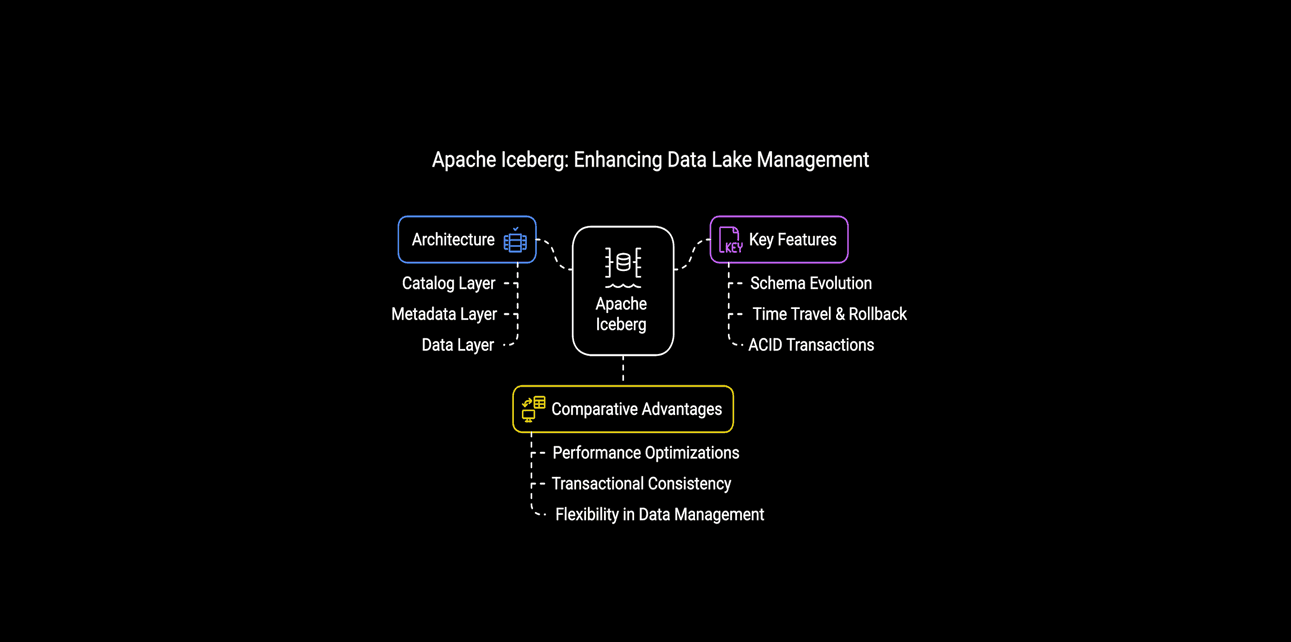
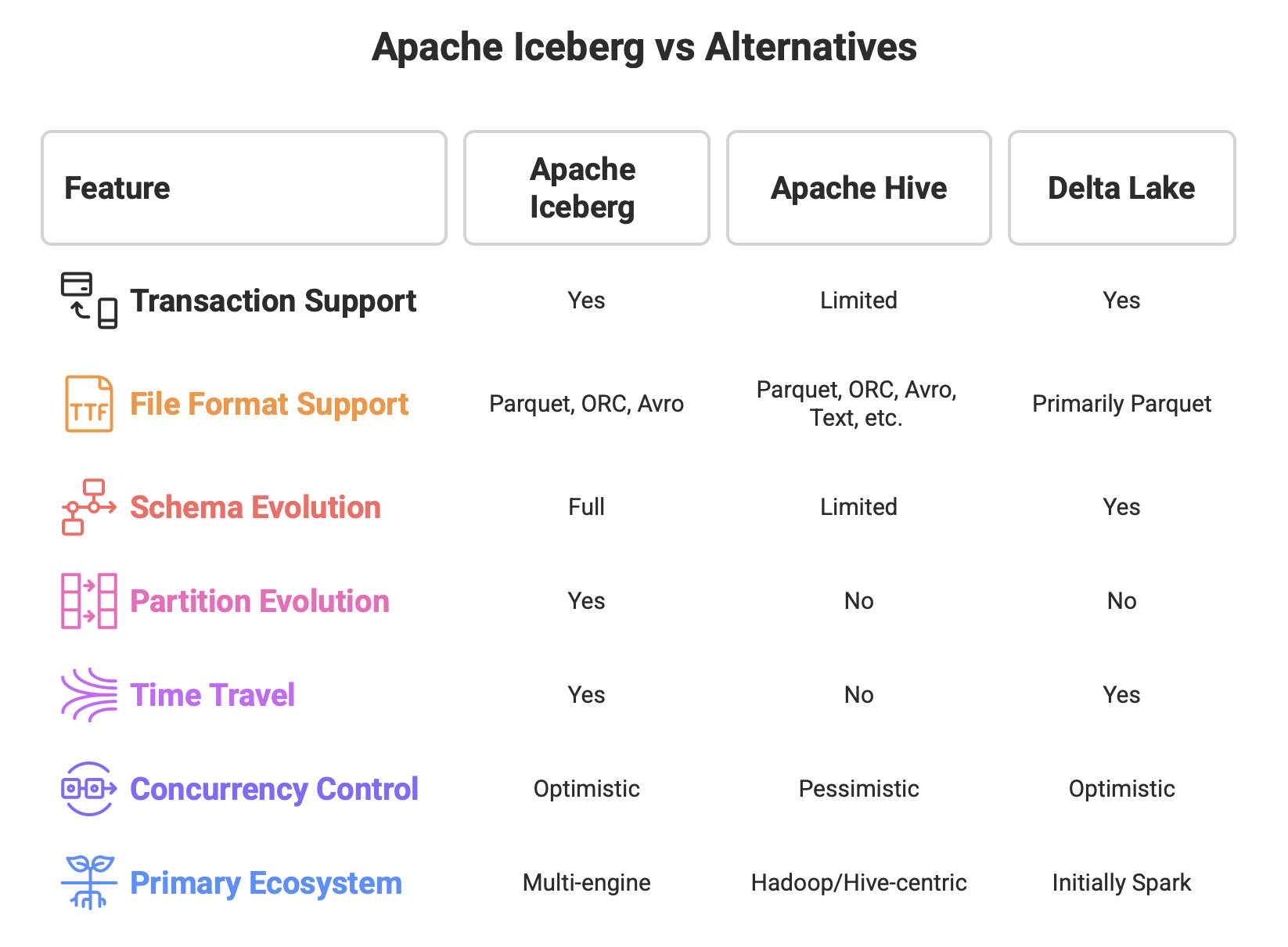
The data landscape has dramatically shifted with the rise of data lakes, designed as vast repositories for diverse data types. However, these initial implementations often fell short, lacking the reliability, structure, and performance guarantees found in traditional data warehouses. Challenges like ensuring transactional consistency across concurrent operations, managing evolving data schemas without disruption, and optimizing query performance hindered their effectiveness for complex analytics. The need for a robust management layer became evident. Apache Iceberg emerged as a groundbreaking open table format designed specifically to address these shortcomings. It aims to bring database-like reliability, efficiency, and familiar SQL interactions to massive datasets residing in data lakes. By providing an intelligent abstraction layer over the raw data files, Iceberg allows users to interact with data lakes more like relational databases. This is achieved through a sophisticated metadata system that meticulously tracks the table's structure, state, and history, enabling reliable data management and significantly faster querying. Iceberg directly tackles the limitations found in earlier systems like Apache Hive. Traditional Hive tables often map directly to directory structures, making operations like schema changes complex and frequently requiring entire table rewrites. Query performance can suffer due to reliance on slow file system listing operations, especially for large tables, and Hive's transactional support is limited. Iceberg overcomes these issues by maintaining a canonical list of data files independent of the directory structure, offering robust schema evolution, performance gains via sophisticated metadata management, and full ACID transactional guarantees.
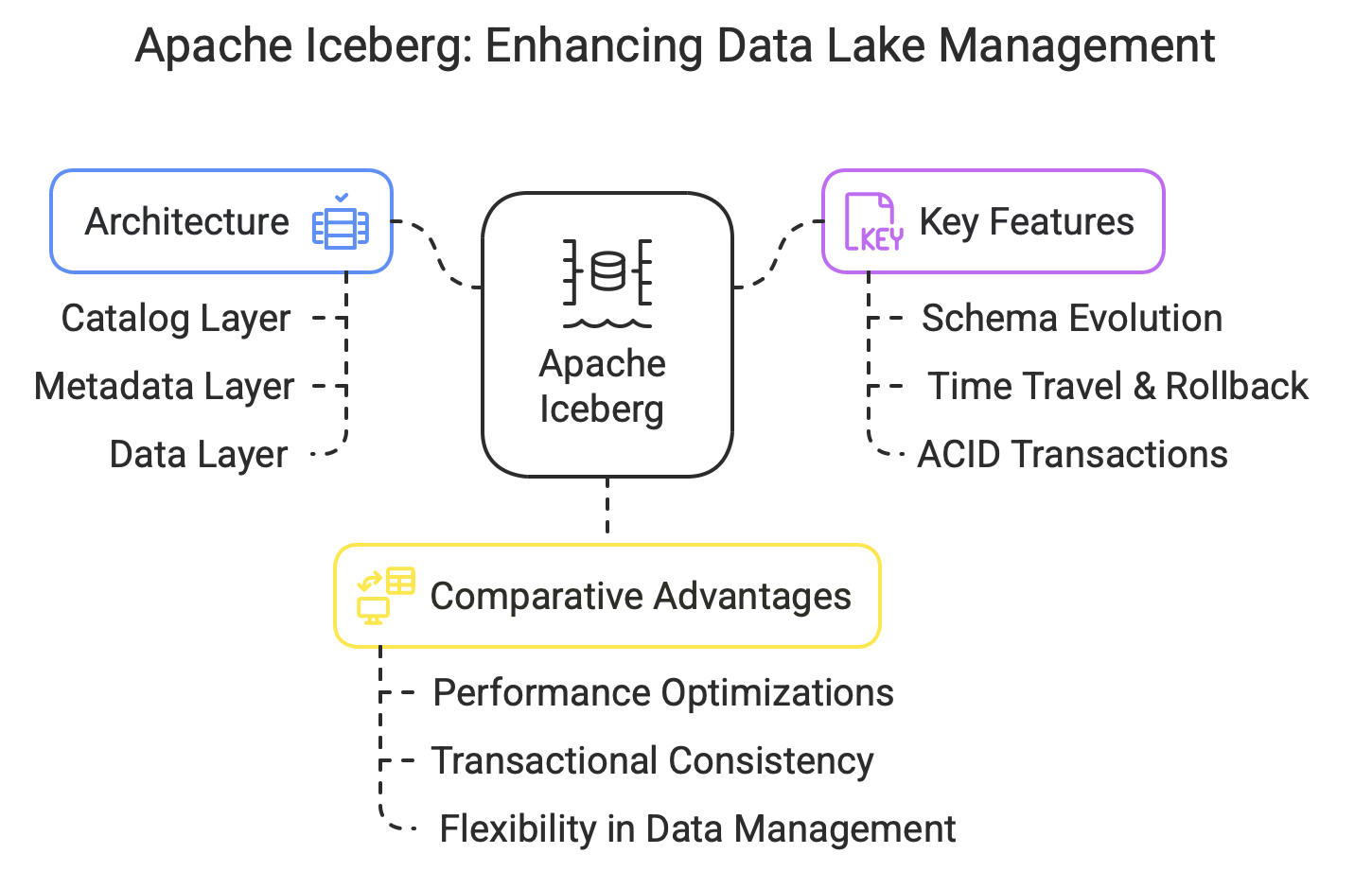
Understanding Iceberg's Architecture
Iceberg's architecture is thoughtfully designed with three distinct layers, separating concerns for clarity and efficiency:
1. Catalog Layer: This is the entry point for any interaction with an Iceberg table. The catalog's primary role is to map a table name (e.g., database.table_name) to the location of its current metadata file. Various catalog implementations exist (like Hive Metastore, AWS Glue, Nessie, JDBC, REST), allowing integration with different environments and offering diverse features.
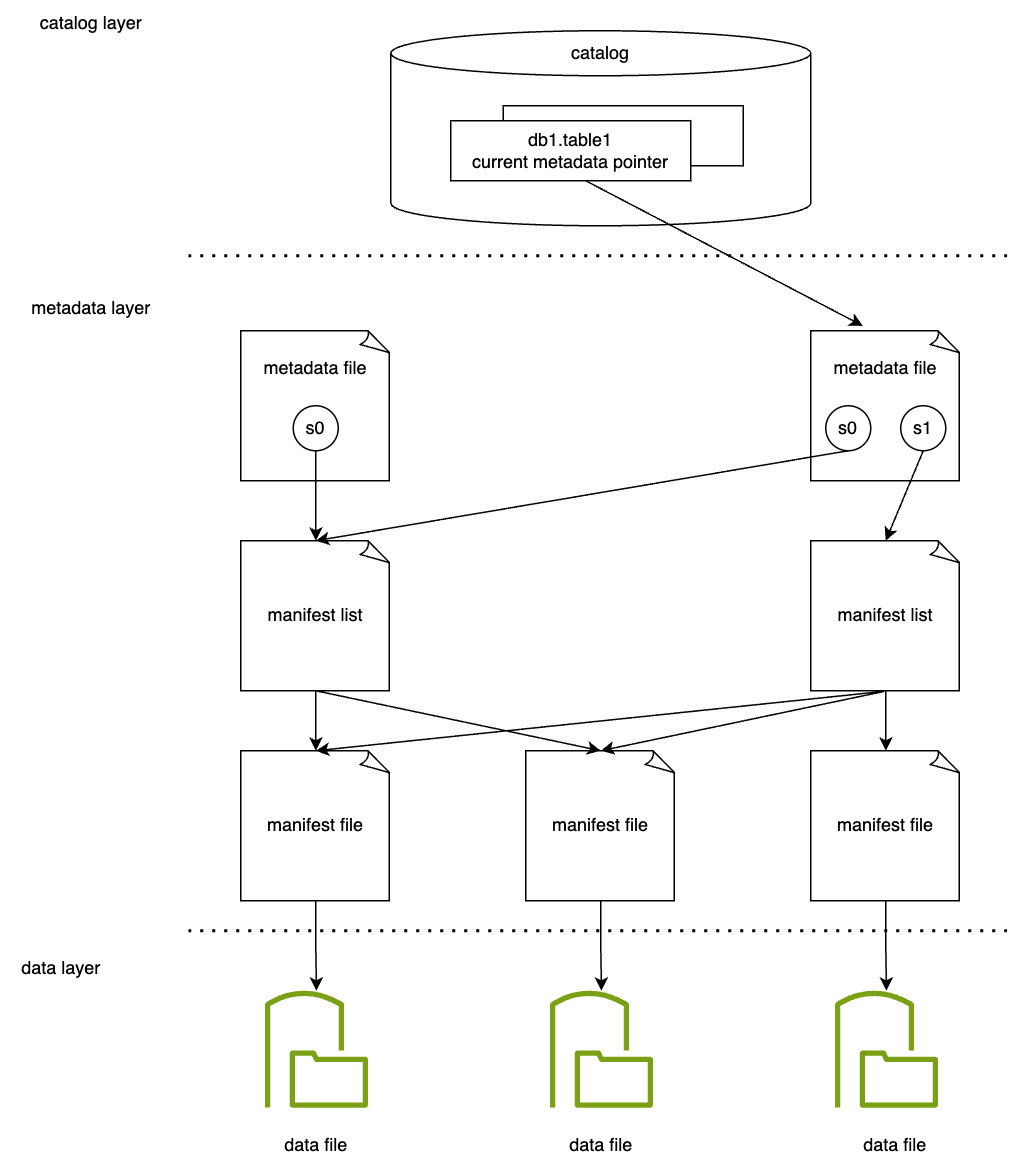
2. Metadata Layer: This is the core of Iceberg, managing the table's state, structure, schema, partitioning rules, and history through immutable snapshots. It consists of three key components arranged hierarchically:
-
Metadata File: A JSON file representing a specific version (snapshot) of the table. It contains crucial information: the table schema, current partition specification, sort order, custom properties, and, crucially, a pointer to the specific manifest list file defining that snapshot. Every change to the table (data or schema) results in a new metadata file being written. An atomic operation (like a compare-and-swap on the catalog pointer) updates the reference to the latest metadata file, ensuring transactional consistency. This immutability is the foundation for time travel and rollbacks.
-
Manifest List: Each snapshot has one manifest list file. This file lists all the individual manifest files that make up that specific snapshot. It stores metadata about these manifest files, including the partition value ranges they cover and counts of added/deleted files/rows. This summary information allows query engines to quickly prune entire manifest files (and thus the data files they track) that are irrelevant to a query's filters, significantly speeding up query planning.:
-
Manifest File: These files track individual data files (and potentially delete files for Merge-on-Read strategies). Each entry in a manifest file contains detailed statistics about a specific data file: its path, file format (Parquet, ORC, Avro), partition membership information, row counts, and crucially, column-level statistics like lower/upper bounds for values and null counts. This granular, file-level metadata is vital for Iceberg's performance, enabling powerful "data skipping" during query execution.
3. Data Layer: This layer consists of the actual data files where the table's rows are stored, typically in efficient columnar formats like Apache Parquet or ORC, residing in your chosen storage system (e.g., S3, ADLS, GCS, HDFS). Iceberg manages the metadata about these files but doesn't dictate the storage system itself.
This hierarchical metadata structure, combined with immutability and atomic pointer updates, allows Iceberg to manage petabyte-scale tables efficiently without creating central bottlenecks, distributing much of the planning work to the client-side query engine.
Key Features Driving Modern Data Lakes
Iceberg isn't just a format; it's a suite of powerful features addressing critical data lake challenges:
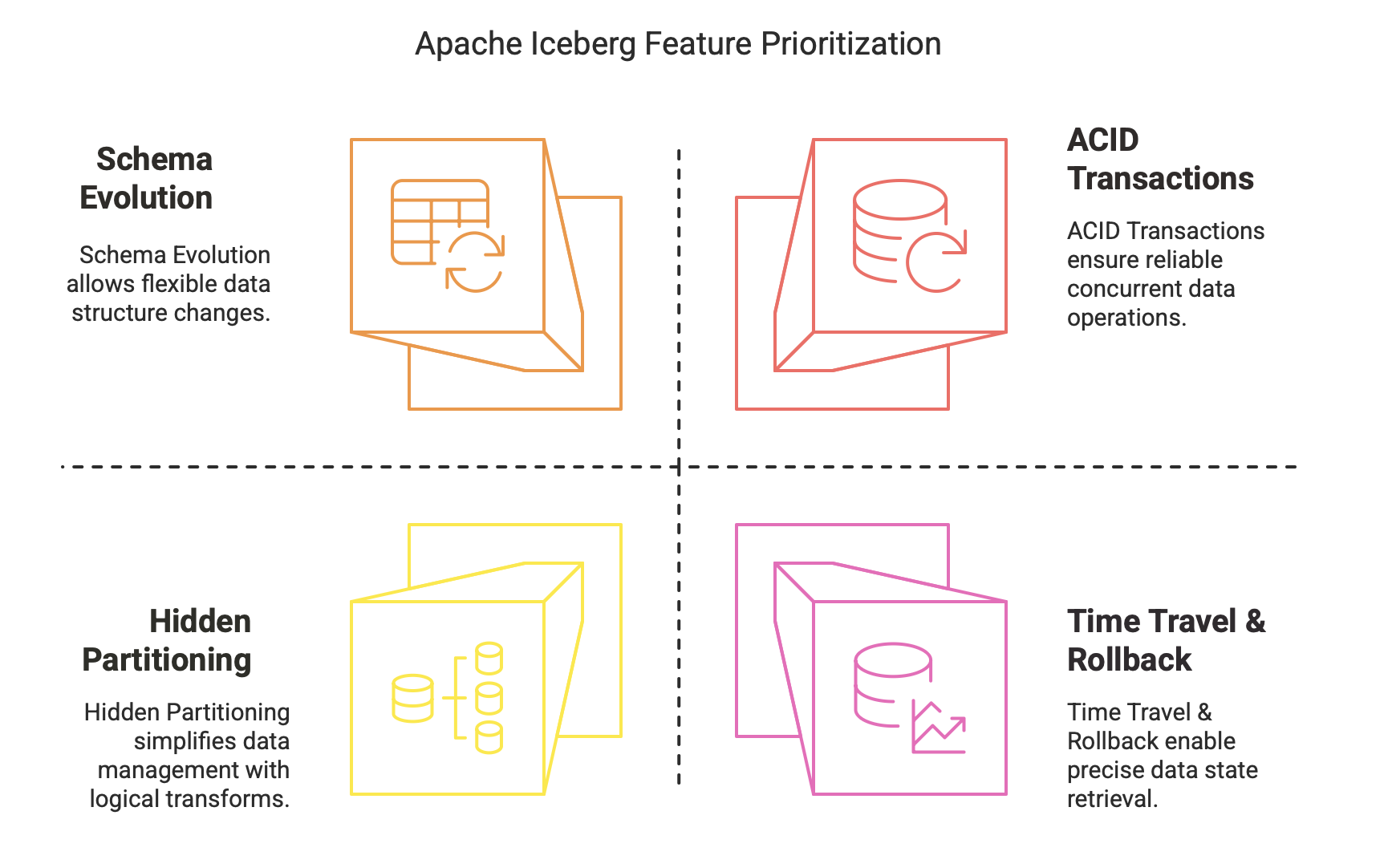
1. Schema Evolution: A standout feature providing unparalleled flexibility. Iceberg allows adding, dropping, renaming columns, updating data types, and reordering columns—even within nested structures—without needing costly data rewrites. This is achieved by uniquely identifying each column with an internal ID, decoupling the logical schema from the physical storage. Schema changes simply involve updating the metadata, which is vital for agile development and evolving business requirements.
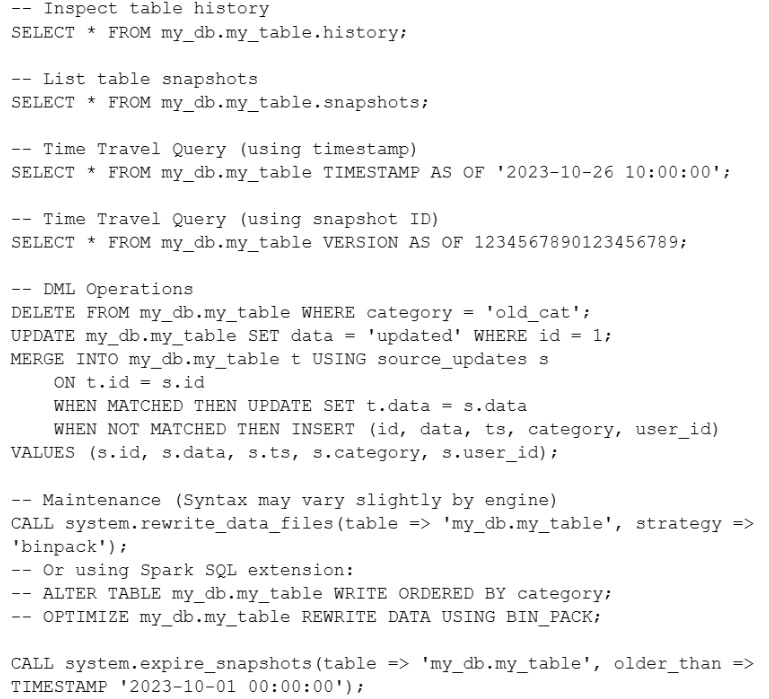
2. Time Travel & Rollback: Access previous states of your table effortlessly. Because every change creates a new, immutable snapshot tracked by metadata files, you can query the table as it existed at a specific past time or snapshot ID. This is invaluable for debugging, auditing, reproducing analyses or ML model training runs, and recovering from errors by simply resetting the table pointer to a previous valid snapshot (rollback).
3. ACID Transactions: Iceberg brings full Atomicity, Consistency, Isolation, and Durability (ACID) guarantees to data lake operations via optimistic concurrency control. This means multiple users or processes can read and write to the same table concurrently without risking data corruption or inconsistencies. Operations are atomic, ensuring the table always remains in a valid state. This is crucial for building reliable data pipelines and enabling complex transactional workloads previously limited to databases
4. Data Compaction: Over time, especially with streaming ingestion or frequent small updates, tables can accumulate many small data files. This increases metadata overhead and slows down queries (due to file open costs). Iceberg provides mechanisms (like Spark's rewriteDataFiles action or specific procedures) to compact these small files into fewer, larger files, optimizing read performance and storage efficiency. Different strategies like bin-packing (target file size) or sorting can be employed.
5. Row-Level Operations: Iceberg provides efficient mechanisms for handling row-level modifications, a common requirement often difficult in traditional data lakes. It supports two main strategies:.
-
Copy-on-Write (COW): When rows in a data file are updated or deleted, the entire data file is rewritten, excluding the deleted rows and including the updated versions of modified rows. This approach results in faster read performance as queries only need to read the current base files, but write operations can be slower and more resource-intensive, especially for frequent, small updates impacting many files.
-
Merge-on-Read (MOR): Updates and deletes are written to separate, smaller "delete files" that record which rows (identified by position or value) in which base data files are affected. Reads require merging the information from base files and corresponding delete files on the fly to produce the current view of the data. This results in much faster writes, especially for incremental updates, at the cost of potentially slower reads.
6. Performance Optimizations: Iceberg significantly accelerates queries by minimizing the amount of data read.
-
Data Skipping: Leverages the column-level statistics (min/max values, null counts) stored in manifest files. During query planning, the engine compares query predicates (e.g., WHERE region = 'US' or WHERE event_time > '2023-10-26') against these statistics to eliminate entire data files that cannot possibly contain matching rows before any data is actually read.
-
Hidden Partitioning: Simplifies management and improves query performance. Users define partitions using logical transforms on columns (e.g., years(timestamp_col), months(date_col), truncate(category_name, 5)). Iceberg automatically calculates partition values and manages the physical file layout. Crucially, users query based on the original columns (e.g., WHERE timestamp_col > '...'), and Iceberg translates this to efficient partition pruning behind the scenes, decoupling the physical layout from the logical query.
-
Partition Evolution: Unlike traditional systems, Iceberg allows you to change the partitioning strategy (e.g., switch from daily to hourly partitioning) as your data volume or query patterns evolve—without rewriting existing data. New data will use the new scheme, while queries seamlessly read across data partitioned with different strategies.
Handling Incremental Updates: A Key Strength
A critical challenge in many data engineering pipelines is efficiently processing incremental updates, such as merging changes from transactional databases or handling Change Data Capture (CDC) streams into the data lake. Traditional methods using Hive often involved complex, brittle, and computationally expensive processes, frequently requiring full partition rewrites even for small changes, leading to high latency and potential inconsistencies.
Apache Iceberg's design directly addresses this pain point:
1. Atomic & Isolated Operations: ACID transactions ensure that a MERGE INTO or UPDATE operation applying a batch of changes completes entirely or fails cleanly, preventing the table from being left in a partially updated, inconsistent state. Optimistic concurrency allows these operations to run alongside analytical queries without blocking.
2. Precise File Tracking: Iceberg's manifests know exactly which data files belong to the table at any given snapshot. Applying updates doesn't involve slow, unreliable directory listings. The engine identifies the specific files affected by incoming changes based on the update/merge conditions.
3. Efficient Updates: By leveraging Iceberg's MERGE INTO statement (or equivalent operations in different engines), engineers can build robust, efficient pipelines that apply CDC streams or batch updates directly to data lake tables. This capability dramatically simplifies ETL logic, reduces data latency, lowers compute costs, and provides the data consistency needed for reliable downstream analytics and reporting.
Getting Started and Exploring Advanced Features
Embarking on your Iceberg journey involves these steps:
1. Environment Setup: You'll need a compatible processing engine (Apache Spark, Flink, Trino/Presto) and an Iceberg catalog (Hive Metastore, AWS Glue, Nessie, REST, JDBC, Hadoop). Configuration involves telling your engine how to find and interact with the chosen catalog. Cloud platforms (AWS EMR, Snowflake, Google Dataproc, Starburst Galaxy, etc.) often provide streamlined setup.
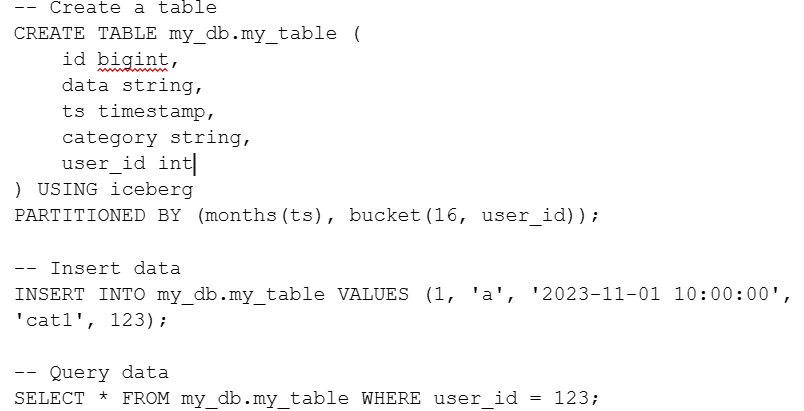
2. Basic Operations: Use standard SQL via your engine.
3. Iceberg-Specific Interactions:
Conclusion: Embracing Reliability and Flexibility with Apache Iceberg
Apache Iceberg represents a significant advancement in managing data within data lakes. Its innovative architecture, focused on robust metadata management and transactional guarantees, directly addresses the historical limitations of these environments. Features like seamless schema evolution, powerful time travel, ACID compliance, intelligent performance optimizations, and efficient handling of incremental updates empower organizations to build truly modern, reliable, and flexible data lakehouse architectures. As demonstrated by use cases like streamlining CDC pipelines, Iceberg unlocks significant value and efficiency. With its vibrant community and expanding ecosystem support across multiple engines and platforms, Apache Iceberg is firmly positioned as a cornerstone technology for modern data management, enabling organizations to harness the full potential of their large-scale data assets.